FP7 — railway signalling
Specifications for a new generation of interlocking systems
Context & objectives
Current European Framework for the Rail Industry
The railway industries throughout Europe face increasing competition with other modes of transport and with other manufacturers from Asia and Russia. They are therefore under constant pressure for cost-effective operations.
To resolve the situation, the European Commission announced a set of new proposals to revitalise the rail transport. The priority to be addressed to solve the problems holding back its development concerns the lack of infrastructure and interoperability between networks and systems. Particular attention has been paid to a critical part of the overall rail system: the signalling system which is highly relevant for the performance and the safety of train operations.
Railway signalling systems transitioning from traditional national solutions towards ERTMS compliance
The convergence of the ERTMS vision in the railway sector, with the accompanying ETCS and GSM-R standards, has brought about a degree of cross border cooperation not previously seen. Railway Operators and Infrastructure Managers are now engaging with a united supply industry to achieve the common goal of an interoperable system, within the framework of European legislation, which potentially forms a set of legal obligations all have to comply with. A set of standards has been created within these obligations but, as with any standardisation process, joint efforts are needed from all parties to translate such work into tangible results.
The new TSI related to Command/Control/Signalling for Conventional Rail foresees that ERTMS will be rolled out over international corridors covering initial inception kernels. The EC and the European Railway Associations together with the Railway Supply Industry have agreed to work closely together to define a realisable migration strategy for ERTMS. This unique cooperation has offered the possibility to coordinate the implementation of the constituent parts of ERTMS - the traffic-management layer, the train communication and train control system.
Further momentum can be added to this process by ensuring that the most significant sub-systems of railway command and control systems, such as interlockings are developed in line with this programme.
Main Objectives
The INESS project will define and develop specifications for a new generation of interlocking systems, and will thus extend and enhance the standardisation process. It will further lead to industry being more directly involved with Infrastructure Managers in developing innovative solutions for the future based on an enhanced and common understanding of the operational requirements needing to be delivered into the railway transportation system.
The project aims to :
 INESS Flyer
-* Develop the business model and cooperation models to support migration strategies for ERTMS.
- Harmonise data file formats, design tools, data transfer for production, data flows linked with system architectures and maximise the knowledge base of owned assets within the railway infrastructure.
- Produce a common core of validated standardised functional requirements for future interlockings.
- Identify the influence of ETCS levels 2 and 3 on the functional architecture and to propose an architecture for interlockings and the adjacent subsystems.
- Provide safety-verified test tools and techniques to enable the testing and commissioning of signalling applications.
- Identify an efficient way for an interpretation of the safety case process according to the relevant CENELEC standard.
Project in brief
- Programme
- European Commission FP7
- Launched
- October 2008
- Completed
- March 2012
- Partners
- 30
- Coordinator
- UIC
- Workstreams
- 8
Organisation
 INESS Management Structure
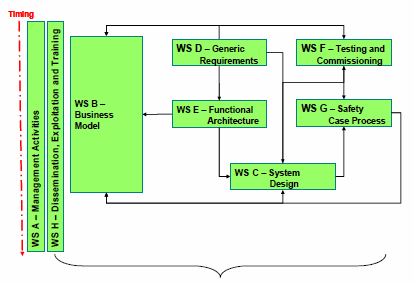
The project is structured around 8 Workstreams, subdivided into 2 to 6 work packages. In order to ensure rapid and coherent management, two levels will be set:
At strategic level, a Steering Board composed of a UIC representative(s), the system suppliers, the railways and the Project Manager, assisted by the Technical Advisory Board.
At operational level, firstly represented by a Project Management Committee (PMC), and secondly by a Project Management Office. The PMC is composed of WS leaders chaired by the Project Manager and is supported by the PMO composed of the UIC project Coordinator and ALMA, which supports the PM in the day-to-day management and overall coordination activities.
Technical information
WS A: Management (Leader: UIC)
Workstream A (Project Management) aims to implement a project management adapted to the specificities of the INESS project and to animate the Consortium. The management structure is composed of three distinct levels:
- A strategic level, composed of a UIC representative(s), the system suppliers, the railways and the Project Manager, assisted by the Technical Advisory Board
- An operational level, represented by a Project Management Committee composed of the Workstream leaders and the Project Manager
- A day-to-day management level represented by the Project Management Office (composed of UIC, WS A leader and ALMA) takes care of the INESS day-to-day management support, and overall coordination activities.
These management bodies will be able to take decisions, involving all partners and covering all major issues (technical, administrative, financial, ethical, exploitation and dissemination and training issues). Adapted tools and internal procedures will be developed for an efficient management of the project. In particular, an Internet Collaborative Platform will be implemented to foster the communication between the partners.
WS B: Business Model (Leader: DB)
Reengineering of the value chain in order to gain cost reduction through highly efficient processes and scale effect due to rationalization and standardization for both suppliers and railway operators.
Propose standards for interlocking interfaces in order to improve interoperability, reduce operating costs and adaptation costs.
Development of a business model to support intelligent migration strategies for ERTMS and therefore to accelerate the realization of European ETCS corridors.
Development of business cases and cooperation models to realize cost reductions within the entire supply chain.
Development of a road map (exploitation plan) towards interoperable, standardized interlocking platforms.
WS C: System Design (Leader: Bombardier)
To harmonise data file formats, design tools, data transfer for production, data flows linked with system architectures and maximise the knowledge base of owned assets within the railway infrastructure.
WS D: Generic Requirements (Leader: ProRail)
The requirements database in a harmonised format and structure. A complete set of functional requirements for interlockings of each of the participating railways. A common kernel of validated standardised functionalities for future interlockings, including functionalities specially required by ERTMS levels 2 and 3. Common method and tooling for verification and validation of the functional requirements.
WS E: Functional Architecture and Interfaces (Leader: BV)
Assess the current architecture of signalling installations with regards to their functional configuration in the context of all their adjacent and neighbouring subsystems. Identify the influence of ETCS in level 2 and level 3. Propose an optimal functional architecture(s) for interlockings with ETCS. Show the apportionment of functionality between the interlocking and the different sub-systems. Based on information about current system and future functionality identify and describe the relevant functional interfaces between the interlocking and the adjacent subsystems.
WS F: Testing and Commissioning (Leader: Network Rail)
Safety-verified test tools and techniques to enable the testing and commissioning of signalling applications including INESS compliant products that will be acceptable in all member states. Development of an optimised testing and commissioning process to facilitate the efficient integration of ERTMS applications into the various member states.
WS G: Safety Case Process (Leaders: Funkwerk/ TUBS)
Analyse the current status and identify the problem areas in the handling of the safety case process in industry. On basis of the analysis identify an efficient way for an interpretation of the safety case process according to CENELEC and develop improvement strategies consistent to the National Safety Authorities. Develop and provide open source support tools for the safety case process. Reduce time and money for the Safety Case in industry by avoiding unnecessary or redundant procedures.
WS H: Dissemination, Exploitation, Training & Coaching (Leader: UIC)
Aim: to ensure the take up of knowledge and results that come out of the INESS project by the relevant stakeholders inside and outside the INESS consortium.
From this main objective 3 objectives / set of activities can be distinguished: The dissemination of project results that evolve from the project during its course and to guarantee the proper diffusion of knowledge using a real platform (to define - possibly the one defined and used in WS F5) primarily developed to demonstrate INESS outcomes. A real interlocking with connection to ETCS simulator might be a solution. To ensure the exploitation of the results that will have to take place when the project has finished and to establish interfaces to standardisation bodies in order to introduce the INESS results as draft standard proposals. The set up of one or more training (and coaching) programme(s) for industry as well as railway infrastructure companies to assure the long term availability of skilled and trained workforce for implementation of INESS results.
Partners & contacts
In order to get a full representation of the rail sector in Europe, INESS has been conceived as a plurilateral & international project. It involves 30 partners across Europe including international railway organisations as well as rail research specialised universities and railway track industry suppliers. The coordination is under the responsibility of the UIC (International Union of Railways). For more information on INESS partners, just click on the company name in the list below.
Partners
 UIC
 ADIF
 Alma Consulting Group
 Alstom
 Ansaldo STS
 AZD
 BBR
 Bombardier Transportation RCS
 DB Netz AG
 Eindhoven University of Technology
 Nucleo
 Funkwerk IT
 Invensys
 MerMec
 Network Rail
 ProRail B.V.
 Railsafe Consulting LTD
 RFI
 RWTH Aachen
 Scheidt & Bachmann
 Trafikverket
 Siemens AG
 University of Southampton
 TIFSA
 Thales Rail Signalling Solutions GmbH
 Technical University Braunschweig
 University Politecnica de Madrid
 University of York
 UNIFE
 German Aerospace Center
Deliverables open to the public
Publications and news
Publication materials
Meetings and events
- 16 March 2012Steering Board
- 07 March 2012Three-day Training Session
- 03 February 2012INESS Final Conference
- 02 February 2012General Assembly
- 02 February 2012INESS General Assembly
- 23 November 2011Steering Board
- 08 September 2011Steering Board
- 11 May 2011Steering Board
- 02 March 2011Steering Board
- 21 January 2011Steering Board
- 25 November 2010General Assembly
- 24 November 2010Steering Board
- 06 September 2010Steering Board
- 19 May 2010Steering Board
- 11 February 2010Steering Board
- 16 December 2009General Assembly
- 05 November 2009Steering Board
- 16 September 2009Steering Board
- 07 May 2009Steering Board
- 21 October 2008Kick-Off Meeting
Presentations in related conferences
InnoTrans 2012
Berlin, 18 - 21 September 2012
With a large number of reference projects and over 220 transport technology firms, Berlin is the main focus of Germany’s transport engineering industry and an ideal venue for InnoTrans, an international platform for buyers and sellers of passenger and freight transport technology. InnoTrans has become established as an international industry showplace focusing on Railway Technology. A full range of rail vehicles are presented in static displays on the Messe Berlin tracks located outside the exhibition halls. Other key InnoTrans features include Railway Infrastructure, Interiors, Public Transport and Tunnel Construction.
UIC ERTMS World Conference, Stockholm 2012
The 2012 UIC ERTMS World Conference will take place in Stockholm from 24 – 26 April.
By bringing together the most knowledgeable professionals in the business to speak on a variety of key topics, the UIC ERTMS Conference 2012 provides a unique forum to take stock of progress and to publicly present the agenda for the future of ERTMS/ETCS.
Transport Research Arena
Athens, Greece, April 23-26 2012 TRA is not just a conference but an arena which aims at bringing together European stakeholders from all areas of transport and transport-related activities. It is with a great satisfaction that we welcome the initiative taken on the occasion of TRA 2012 to extend the scope of the conference to all modes of surface transport: road, rail and waterborne. A renewed TRA, covering all transport modes but also urban transport planning and mobility as well as co-modality, is precisely what the European Commission was calling for. This will happen in Athens in 2012.
For more information about the conference please consult the dedicated web-site http://www.traconference.eu

Workshop at the University of York on 27th September 2011
Railway Safety Technology Research Centre Software Assessment and Certification for Railway Applications: Technology Challenges and Opportunities
Improving the transparency of the safety argumentation – Results of the EU-Project INESS
Dr Jörg Müller, Institute for Traffic Safety and Automation Engineering - University of Braunschweig
Improving the transparency of the safety argumentation – Results of the EU-Project INESS
FP7 Mid-term Evaluation
16-17 June, BUdapest, Hungary The FP7 Mid-term Evaluation Event will present the findings and engages parties to discuss the implications for the future.

COMADEM 2011
24th International Congress on Condition Monitoring and Diagnostics Engineering Management Stavanger, Norway, 30 May - 1 June 2011
The congress covered all aspects of performance monitoring, health management, failure diagnosis, risk, reliability, maintenance, etc.
Approach for successful LCC Data collection and analysis Christian HOFFART, Thomas HIRSCH
COMADEM 2011
WCRR 2011
9th World Congress on Railway Research Lille, 22-26 May 2011 The WCRR 2011 is an outstanding international meeting whose target is to promote exchange between researchers, manufacturers and operators as well as to share their experience.
It’s the best opportunity for promoting and fostering research’s added value for the transport world as a whole and more particularly for its clients, freight and passengers through the stakes of future mobility.
For the WCRR 2011 edition, the international community of railway research made its contribution through eight federating and innovating challenges that are definitively client oriented.
WCRR Lille
WCEAM 2010 Fifth World Congress on Engineering Asset Management
Brisbane Queensland, Australia, 25-27 October 2010
The fifth World Congress on Engineering Asset Management (WCEAM-AGIC 2010) was held in Brisbane Queensland, Australia from 25-27 October 2010, incorporating the 2010 Annual Conference of the Australian Green Infrastructure Council (AGIC). The objective of WCEAM is to bring together academics, practitioners and scientists from all around the world:
to promote research, development and application in the field of Engineering Asset Management; to strengthen the link between academic researchers and industrial practitioners in the field; to showcase the state of the art systems and technology in Engineering Asset Management.
LIFE CYCLE COSTING IN HIGH COMPLEX INDUSTRIES – DEVELOPING AND APPLYING A LIFE CYCLE COSTING APPROACH IN THE RAILWAY INDUSTRY Christian Hoffart, Philipp Stüer
WCEAM2010Connecting IT and Transport
Munich, 9 November 2010
Harmonising Safety Cases (INESS) Carsten Trog

AKIDA 2010
For the past 14 years, the goal of the Aachen Colloquium for maintenance, diagnostics and system monitoring was to offer a biennial platform for the active and constructive exchange between industry and research. Achieved with increasing success, AKIDA has become the major symposium in the area of system monitoring and maintenance in Germany.
Life Cycle Costing für komplexe Investitionsgüter – Instandhaltungskosten im Lebenszyklus europäischer Bahnstellwerke Philipp Stüer
AKIDA 2010
INNOTRANS 2010
International Trade Fair for Transport Technology Innovative Components, Vehicles, Systems -
21-24 September, Berlin
With a large number of reference projects and over 220 transport technology firms, Berlin is the main focus of Germany’s transport engineering industry and an ideal venue for InnoTrans, an international platform for buyers and sellers of passenger and freight transport technology. InnoTrans has become established as an international industry showplace focusing on Railway Technology. A full range of rail vehicles are presented in static displays on the Messe Berlin tracks located outside the exhibition halls. Other key InnoTrans features include Railway Infrastructure, Interiors, Public Transport and Tunnel Construction.

ESREL 2010 Annual Conference
The annual ESREL Conference stem from a European initiative merging several national Conferences into a major yearly conference under the auspices of the European Safety and Reliability Association (ESRA).
The conference provided a forum for presentation and discussion of scientific papers covering theory, methods and applications in the fields of risk, safety and reliability to a wide range of sectors and problem areas.
ERSEL Presentation

The IMS Summer School: Manufacturing Strategy
First Edition 2010: Sustainable Manufacturing ETH Zurich, May 26-28, 2010
The IMS Summer School 2010 on Sustainable Manufacturing approaches two evolving research topics: Sustainable lifecycle of products and production systems Sustainable products and production, services and maintenance
Young researchers and industry practitioners with special interest in these topics were invited to present problems, share knowledge and discuss these topics in plenary and parallel sessions during the summer school. Participants from research presented research projects Participants from industry presented real challenges and discuss solutions
Paper - IMS Summer school 2010 LCCSoftware Technologies Concertation on Formal Methods for Components and Objects
4 - 6 November 2009

Part of the Formal Method week, Eindhoven The Netherlands
For more information please consult the FMCO web-site
19th International Railway Safety Conference 2009
Båstad, Sweden, 28 September – 02 October 2009
IRSC is an event that is organised by the sector, for the sector and is not for profit. It is a forum that brings together rail safety professionals from around the globe in order to exchange information and provide experiences and lessons learned in rail safety. As running a rail network safely involves most if not all the sub-systems of the rail architecture, IRSC extends to a wide range of subject areas.
The 5 core themes of IRSC 2009 were:
1. Safety management in a changing world 2. Human behaviour in a complex system 3. How safe is safe enough? 4. Safety and security – harmonised or conflicting goals 5. Safety standards – harmonisation or uniformity
Around 140 participants from 22 countries with representation from all 5 continents were in Båstad.
Presentation Carsten Trog & Jörg Müller Safety Case ProcessERTMS World Conference
This year the UIC ERTMS World Conference was held in Malaga, Spain, from 31 March to 2 April 2009.
The programme included keynote speeches and presentations on the latest developments, issues and challenges surrounding the adoption of ERTMS by Infrastructure Managers and Train Operating Companies (Railway Undertakings).
The conference attracted 800 participants from around the world, bringing together representatives from leading railway organisations and associated companies.
In tandem with the conference was the ERTMS exhibition, held in a dedicated 5000m² space within the conference venue, where visitors had the opportunity to liaise with UIC (organisers), participating UNIFE members, GSM-R industry representatives and prominent professionals from railway signalling and telecommunications.
Representing railway signalling, the European INESS project was also presented at the exhibition. INESS project representatives were available to inform participants and visitors about the latest developments.
Printed information about the project is available at UIC for your information.
8th World Congress on Railway Research

The 8th World Congress on Railway Research (WCRR 2008), the world’s largest railway festival was held in Seoul between May 18 and 22 co-hosted by KORAIL, KR and KRRI. The 5-day event was attended by 800 CEOs and experts in the railway sector from 50 countries across the world. Under the theme ’Towards a Global Railway’, the congress consisted of academic sessions, exhibition and technical visits.
"ERTMS compliant interlockings - INESS project - INtegrated European Signalling System" was presented by Paolo de Cicco (UIC), Peter Winter (SBB Consulting), Andy Doherty (Network Rail) and Frans Heijnen (Invensys Rail Group).
INESS Presentation - WCRR 2008 INESS presentation - Abstract - WCRR 2008Conference papers
INESS Final Conference 2012
The INESS FINAL CONFERENCE**
February 3, 2012 - UIC HQ, Paris
The INESS project launched in October 2008 will be coming to an end in March 2012.
To mark the end of the project and present its results
INESS Final Conference will be held at UIC Paris on February 3, 2012.
The one-day free conference will consist of two half-day sessions : The morning session, from 9am to 12 pm, will include the presentations on projects results and lessons learned; The afternoon session, from 1pm to 4pm, will consist of:
- Market place - to showcase the results, tools and methods used
- Break out sessions to discuss specific topics.
The Conference is open to all EU participants.
Background
The main objective of INESS is to define and develop specifications for a new generation of interlocking systems and apply methods and tools capable of reducing LCC and enhance the standardisation process. In the context of the current European policies, it is expected to foster hereby migrations of signalling equipment and support the rollout of ERTMS. The European Commission and the European Railway Associations, together with the Railway Supply Industry, are working closely together to define the efficient migration strategy for ERTMS. This unique co-operation has offered the opportunity to harmonise the functions, architectures, interfaces and connections of the interlocking as a constituent of signalling involved in ERTMS. INESS will therefore support the development of a new generation of interlocking systems with optimal unified conception and interfaces towards adjacent systems such as the ETCS - Radio Block Centre and the outdoor equipment, in particular connecting to the ETCS.
Who You Will Meet
The conference will be of interest to :
- all railway Siganlling and Procurement professionals;
- IMs;
- Industry Executives whose primary functions involve Business and Financial development and project management;
- Transport ministries representing European Governments;
- European standardisation bodies and authorities.
Benefits of Attending: Delegates will
- Understand Project Results and lessons learned
- Learn INESS advantages for the Railways and INESS advantages for the Industry
- Discuss in detail specific topics
- Benefit from networking opportunities with peers and vendors
Programme
For more information about the event, please consult the conference program:
INESS Final Conference AgendaREGISTRATION FORM on-line
Please click here to register on-line
For further information about participating in the conference please contact :
Maria Lafont; WS H Leader
e-mail : lafont@uic.org Tel: (33) 1 44 49 20 24 Fax: (33) 1 44 49 20 28
** The confernece is FREE. All expenses related to the conference are covered by INESS. Participants will have to cover their own travel, lodging and meal expenses, except for the meals provided during the Conference as indicated in the program.
Final conference documents
Three-day training session 2012
The INESS project launched in October 2008 will be coming to an end in March 2012.
To mark the end of the project, present its results and to assure the long-term success of INESS and the availability of skilled and trained workforce for the implementation of INESS results :
Three-day INESS Free Training session will be held on March 7-9, 2012, UIC Paris**
Background
The main objective of INESS is to define and develop specifications for a new generation of interlocking systems and apply methods and tools capable of reducing LCC and enhance the standardisation process. In the context of the current European policies, it is expected to foster hereby migrations of signalling equipment and support the rollout of ERTMS. The European Commission and the European Railway Associations, together with the Railway Supply Industry, are working closely together to define the efficient migration strategy for ERTMS. This unique co-operation has offered the opportunity to harmonise the functions, architectures, interfaces and connections of the interlocking as a constituent of signalling involved in ERTMS. INESS will therefore support the development of a new generation of interlocking systems with optimal unified conception and interfaces towards adjacent systems such as the ETCS - Radio Block Centre and the outdoor equipment, in particular connecting to the ETCS.
Training objectives
The INESS training programme setup will contain:
- Explanations on benefits of a common method for describing functionalities to the railway asset managers.
- Dissemination about the common kernel and explain the advantage for infrastructure managers, industry partners and safety authorities.
- Explanations on the advantages of using the common kernel in order to convince standardisation bodies to work towards a European standard.
- A presentation about the Interlocking-RBC interface FFFIS, focusing on the benefits of standard interfaces.
- A demonstration on advantages for infrastructure managers, industry partners and safety authorities in each country on using the INESS architecture/ interface specifications.
- Demonstration on the process towards a proposal for a standardised system architecture to standard setting and regulatory bodies, safety authorities and the European Railway Agency.
- A presentation about the harmonised testing and commissioning of interlockings explaining the advantage for infrastructure managers, industry partners and safety authorities in each country.
- The use of the work bench in projects.
Who you will meet
- Railway Infrastructure Managers - Management & Engeneering level
- Suppliers - Management & Engeneering level
- Railway operators
- Industry
- Data managers and Project managers
- Procurement department from the European Railways
- Business development and Financial department from the European industry
INESS Training Programme
INESS Training ProgrammeINESS Training Programme - Documents
INESS Training Day 1 presentation INESS Training Day 2 presentation INESS Training Day 3 presentation WS F Handbook GSN-Tool ManualREGISTRATION FORM on-line
Please click here to register on-line
Practical Information
Practical information - Training programHotels
How to get to UIC
How to get to UICFor further information about participating in the Training course please contact :
Maria Lafont
e-mail : lafont@uic.org Tel: (33) 1 44 49 20 24 Fax: (33) 1 44 49 20 28
** The Training session is FREE. All expenses related to the Training are covered by INESS. Participants will have to cover their own travel, lodging and meal expenses, except for the meals provided during the Training as indicated in the program.